

The girl had heart … and so did the boy
October 20th, 2010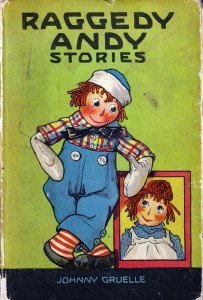
They really look like they’re in love, don’t they?
If you’re a female of any age, the chances are excellent that you once owned a Raggedy Ann doll. I did and I loved to undress her so I could see her heart. What a lovely touch. I don’t have mine any more, but I have this Raggedy Andy book, well worn and well loved. According to the article in Wikipedia, this book first introduced Raggedy Andy, and since the date on the book is 1920, it might be a first edition. But it’s in bad shape with tears and repairs, a dirty cover and someone (me? my sister?) pencilled in page numbers. Children shouldn’t write in books, but we hated books with no numbers. It has the name of a friend of my aunt’s in pencil so I’m guessing she was the original owner of the book in 1920. She probably gave it to my grandmother to share with my sister and me. I remember reading it there.
The stories are pretty long according to today’s standards. The illustrations are really lovely. The one in Wikipedia is in this book. I’ve chosen this illustration because it has the Scottish doll and the Dutch doll who are also in the stories. 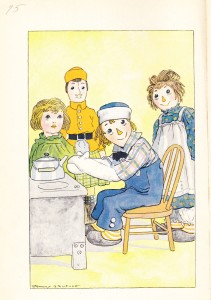
There’s a strange, sad twist to the story. Johnny Gruelle created Raggedy Ann for his daughter, Marcella. Raggedy Andy is dedicated “To Marcella’s mama.” However, Marcella died at age 13 after she received a smallpox vaccination at school without her parents’ permission. Whether or not that was the cause of death, the Gruelles went on to lead an anti-vaccination campaign (sound timely?) and Raggedy Ann was the symbol.
Did you have a Raggedy Ann doll? Did boys have Raggedy Andy dolls? Do your children or grandchildren have Raggedy Ann dolls? The ones today are much brighter than the one I had.
 Multiple generations have loved the exploits of
 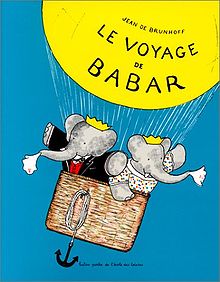 But I can’t mention jungle animals without mentioning my beloved Babar. I say “my” because I adored the Babar books so much. I could read a Curious George book quickly and I’d “gotten” it. But with Babar, I spent long dreamy hours studying the pictures and the world they depicted. By today’s standards, they might not hold up as well, especially because of controversy over the books, saying they justify colonialism.
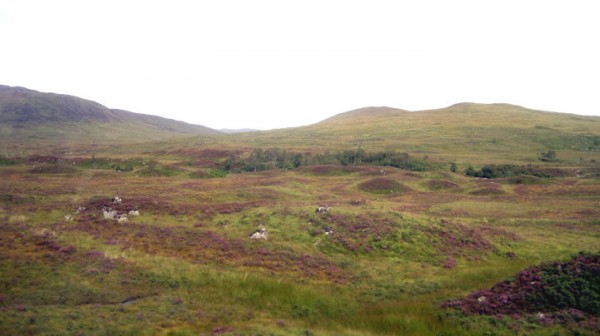
 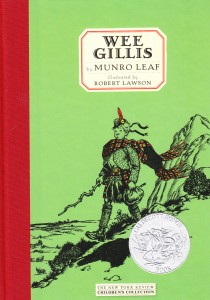 I’m back to blogging about children’s books but I can’t quite let go of Scotland yet … so I found a Caldecott Honor Book from 1938 with a Scottish theme from those wonderful guys who brought you Ferdinand, Munro Leaf and Robert Lawson. I do remember checking this out from the library when I was a child. Here’s a quote from a New York Times review: “The pictures of the Lowland farms and the craggy Highlands of Scotland have sufficient beauty to make anyone who comes from that lovely country homesick for its hills and heather. ”
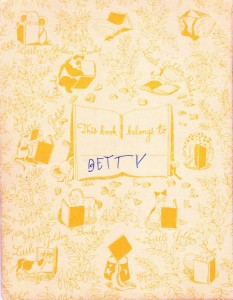 Like many readers, my long love affair with books may have started with a Golden Book! How great to write my name in it … even if I still had trouble with my Ys. What Golden Book stands out in your memory? I know there’s at least one.
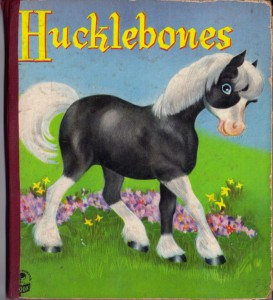 No, these three books haven’t been banned. They’re just old and out of print. They weren’t classics, like many of the books I loved as a child. But as the worn and taped edges of these books show, they were well-loved. If you want to read them, you’ll have to come to my house!
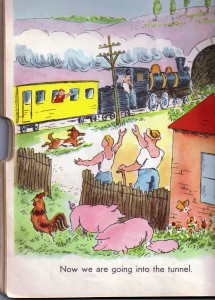 Forget TV – what I loved about these books were the illustrations. I wish I could put up all the spreads from The Choo-Choo Train (illustrations by Oscar Fabres). They capture the glory days of train travel and a very different America. Of course, it was that 1950s- fictional-idealized America. Still it makes me look forward to our 10 day train trip through the Scottish Highlands coming up in early September.
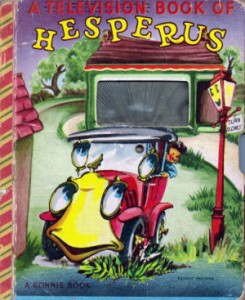 Hesperus really tickled my fancy. Most publishers today shun characters which aren’t humans or animals. However,
  Facebook
 Twitter